From the Toronto Star
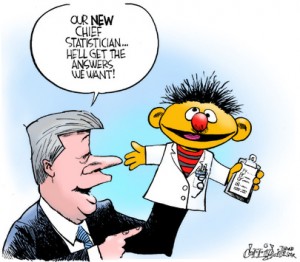
by Patrick Corrigan
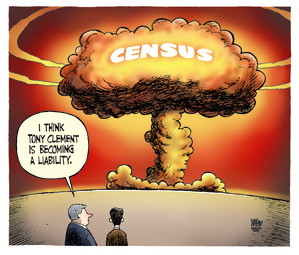
By Theo Moudakis
By Michael de Adder
urging governments to make data about canada and canadians free and accessible to citizens
You are currently browsing the archive for the datasets category.

This list is now being updated daily on the Census Watch Page.
List of Organizations Opposed to Changing the Long Form of the Census
This list was compiled by W. T. Stanbury (wstanbury@prodigy.net.mx) and Armine Yalnizyan, Canadian Centre for Policy Analysis [last update:July 20,2010 ]
Yup! I am not sure I would want all the personal data in the dbase public, but the non private stuff, such as the images that do not identify the persons and the associated metadata describing the tattoos would be a really interesting research too for those doing body studies.
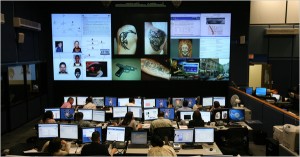
Inside the New York Police Department's Real Time Crime Center, analysts search databases for information gleaned from arrests, accident reports and victim complaints. By MICHAEL S. SCHMIDT Published: February 17, 2010
The database is part of the New York Police Department’s Real Time Crime Center. Wholly tomoli it also includes
a database for body marks, like birthmarks and scars. It keeps track of teeth, noting missing ones and gold ones. It keeps track of the way people walk: if there is a limp, it notes its severity. And it has a so-called blotchy database, of skin conditions…The databases are fed, in part, by arrest reports; officers are instructed to take detailed notes and enter them into a computer program that moves the information to a large server…The databases pull from 911 calls, arrests, complaints filed by victims, reports on accidents and moving violations.
It seems that some tattoos lack a bit of originality. A keyword search on ‘I love you’ yields 596 hits!
To use the tattoo database, detectives can enter either words or images they believe may be in the tattoo. A search request can also include the part of the body that bears the tattoo…“Jailhouse tattoos, tribal tattoos, those are sometimes hard to write down descriptions for because either we don’t know what they are or what they mean,” Sergeant Lonergan said. “Asian symbols are easier.”
When is information too much information? In this case it is a fine line. In my naive optimist days, we would only want this information for cultural research. My realist side tells me that there are many ways to find the bad guys. Crime is down in New York, even if there is debate about juking the stats. As stated earlier socio-anthropological research potential of this dbase if accessible in a way where the private information is kept out, would just be sublime though!
NY Times articles Have a Tattoo or Walk With a Limp? The Police May Know and Retired Officers Raise Questions on Crime Data.
I can’t recall where I found this, but it’s very very cool:
This, I love:
The Open Dinosaur Project was founded to involve scientists and the public alike in developing a comprehensive database of dinosaur limb bone measurements, to investigate questions of dinosaur function and evolution. We have three major goals:1) do good science; 2) do this science in the most open way possible; and 3) allow anyone who is interested to participate. And by anyone, we mean anyone! We do not care about your education, geographic location, age, or previous background with paleontology. The only requirement for joining us is that you share the goals of our project and are willing to help out in the efforts.
Want to sign up? Email project head Andy Farke (andrew.farke@gmail.com), and welcome aboard!
[via datalibre]
Last night I attended the Town Hall Discussion on The Future of the Internet: Access, Openness and Inclusion. There was a hint from the moderator Marita Moll that Industry Canada as part of its Broadband Program might be releasing a map of Canadian broadband. There has been some interesting discussion in the US about access to broadband data at Off the Map and a podcast at All Points Blog. An E-Scan report has been done in Ontario on possibilities for the development of a Broadband Atlas for Ontarians. In all cases access to infrastructure data are highlighted as barriers, particularly as infrastructure has increasingly become privatized and splintered.
The City of Vancouver will soon vote on a Motion to have:
CBC News: Vancouver mulls making itself an ‘open city’, by Emily Chung
It is quite surprising that this was not the norm, to manage the public good!
the Federal Court of Canada released late yesterday that it will force the federal government to stop withholding data on one of Canada’s largest sources of pollution – millions of tonnes of toxic mine tailings and waste rock from mining operations throughout the country.
The Federal Court sided with the groups and issued an Order demanding that the federal government immediately begin publicly reporting mining pollution data from 2006 onward to the National Pollutant Release Inventory (NPRI). The strongly worded decision describes the government’s pace as “glacial” and chastises the government for turning a “blind eye” to the issue and dragging its feet for “more than 16 years”.
I look forward to reading the court order. According to Ecojustice (Formerly the Sierra Legal Defence Fund) the ruling includes the following strong wording:
* It calls the federal government’s pace “glacial”[paragraph 145];
* It says the government’s approach has been simply to turn a “blind eye”[207];
* It notes that the frustration felt by advocates trying to uncover this information “after more than 16 years of consultation” is “perfectly understandable” [124];
* It states that not reporting “denies the Canadian public its rights to know how it is threatened by a major source of pollution”[127];
* It highlights that the minister has chosen not to publish the pollution data “in deference to” the mining industry[220];
* It used unusually simple language even I understand when it said that the government was simply “wrong”[177].
The advocates were: Justin Duncan and Marlene Cashin and their dedicated clients at Great Lakes United and Mining Watch Canada who launched the case in 2007.
It is uncertain how these data will be released. Currently, these types of pollutant data are released on the National Pollutant Release Inventory (NPRI) which is:
The National Pollutant Release Inventory (NPRI) is Canada’s legislated, publicly accessible inventory of pollutant releases (to air, water and land), disposals and transfers for recycling. (Mining Watch)
The NPRI is fairly usable & accessible, includes georeferencing and some mapping services. I tried to use their library and it was however not working!
The Mining Association of Canada wants to read the ruling “carefully” to assess how Environment Canada should release these data. I find this confusing, since I thought the Government got to decide how these data are to be released and what is to be included, and that decision was based on ensuring the public good and the public right to know. The fight is not yet quite over. It will be important to ensure the data are not watered down for public consumption.
It is another wonderful example of creating an infrastructure – NPRI + law – to distribute public data. This also teaches us something about gouvernementalité, and who the government thinks with, in this case the mineral and mining industry and not citizens. Citizens should not have to lobby for 16 years and expend incredible resources to get the courts to get the government to ensure the public good!
Articles:
Mining Watch Press Release: Court Victory Forces Canada to Report Pollution Data for Mines, Friday April 24, 2009 11:31 AM
Canada Institute for Scientific and Technical Information (CISTI) is
Canada’s national science library and leading scientific publisher, provides Canada’s research and innovation community with tools and services for accelerated discovery, innovation and commercialization.
CISTI delvers science data and information to Canadians online, in the Depository Service and as paper delivery service to researchers in Universities. But its days of doing that are numbered…
CISTI has just suffered very serious budget cuts – 70% cut – that affects scientific innovation, access to scientific data, the dissemination of Canadian Science and open access publishing.
The Government of Canada and the National Research Council of Canada have decided that the journals and services of NRC Research Press will be transferred to the private sector.
Privatization? In a sense they are a victim of their own success. The NRC frames it as follows in a letter to their clients (e.g. Depository Service Program):
this transformation is not the development of a “new business” but the movement of a successful program into a new legal and business environment. It is our belief that this new environment will afford us more flexibility to manage our publishing activities.
More flexibility to reduce services to Canadians more like it since the Depository Services Program (DSP) and the delivery of online access to journals to Canadians cannot be funded by an entity outside of the Federal government, and it is expected that the termination date to journals delivered in this way will be sometime in 2010.
This means less access to scientific journals to Canadians. Research Canadians have paid for! CISTI journals deposited in the DSP were important, since the DSP’s:
primary objective is to ensure that Canadians have ready and equal access to federal government information. The DSP achieves this objective by supplying these materials to a network of more than 790 libraries in Canada and to another 147 institutions around the world holding collections of Canadian government publications.
In addition, hundreds of government jobs – scientists, librarians and researchers are expected to be lost. The budget cut is $35 million in annual expenditures.
This plan includes a reduction in NRC’s a-base funding totalling $16.8 million per year by 2011-2012 (announced in Budget 2009) as well as reductions in revenue-generating activities.
Hmm! Wonder what our current Federal Minister of State for Science and Technology’s thoughts are about science?
Here are a couple of articles:
Actions:
Here are a few articles:
Action:
November issue of Genome Technology focuses entirely on Open Access openly available under a CC license. The articles discussed both data and publications. Wonderful! See page 40 of the journal to read Ready or Not, Here Comes Open Access.
Via: SPARC, the Scholarly Publishing and Academic Resources Coalition
Tags: Add new tag
Comments on Posts